Bundle verdict aligned install, runtime, load proof, and detailed status.
OpenClawBrain lifecycle
What happens to your history after install.
OpenClawBrain starts on a real OpenClaw host, not a toy graph. On the exercised host at
/Users/guclaw/.openclaw, the latest proof bundle returned success_and_proven
with a promoted pack live and a learned route function available.
This page covers the rest of the chain: init gives the attachment boundary, harvest turns surfaced history into candidate structure, replay gates promotion, and the runtime serves bounded context instead of raw-history prompt sprawl.
Real host snapshot: what the healthy lane proves today
A real host capture from March 27, 2026 after install, load, serving, and reporting lined up.
Detailed status also reported serve state=serving_active_pack and routeFn available=yes.
Strongest live block: human-label-harvest.
Plus 32 supervision artifacts and 58 updates.
Source: detailed status, proof summary, and the exercised-host bundle captured March 27, 2026.
The story should fit in three ideas
If the story gets longer before it says these three things, it is backwards.
Read the important things you already have
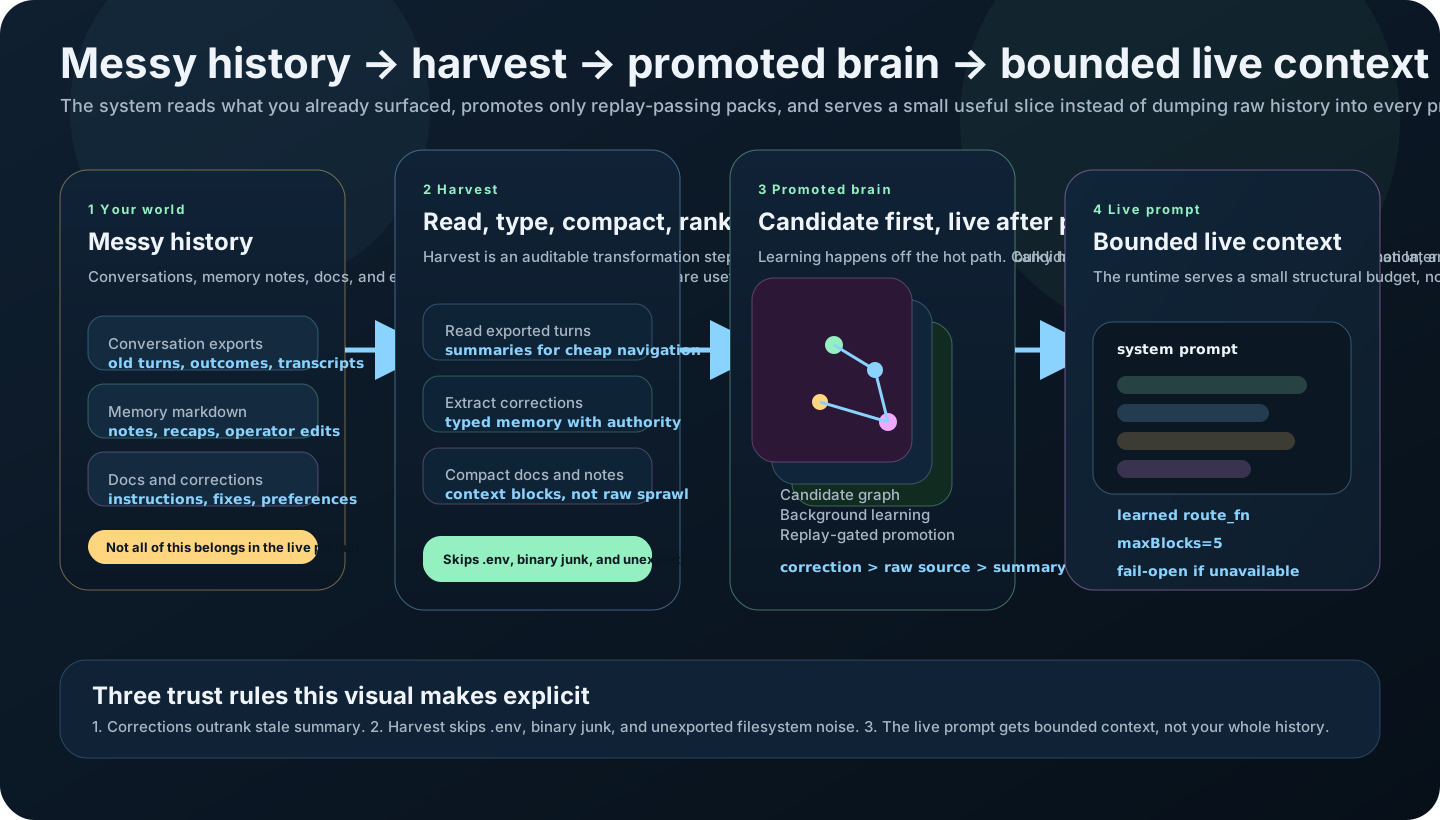
Conversations, memory notes, docs, and corrections become candidate graph material without dumping them wholesale into the prompt.
Learn in the background and only serve promoted packs
Candidate structure is replay-gated before promotion. The live runtime serves proven packs, not half-written learning artifacts.
Inject a small useful slice
Summaries help navigation, raw source expands for detail, and corrections can win when history conflicts. The prompt stays bounded.
What the graph looks like after INIT
Init should make the runtime attachable and inspectable. It is a scaffold, not a finished brain.
Earlier init runs stayed tiny on purpose
An earlier init run produced 3 nodes and 4 edges. Small on purpose makes first-run state visible.
The initial pack is still a baseline, not a mature brain
The current host still retains an initial pack with 8 blocks, 0 human labels, and 0 structural ops.

BRAIN LOADED. The learned graph is still small. That is healthy.
Install gives the attachment boundary. Real turns, exports, corrections, replay, and promotion make the graph useful.
What gets harvested - and what does not
You already have conversations, memory markdown, docs, and corrections. Harvest turns those surfaced inputs into candidate graph material without crawling your whole filesystem.
Exported turns become searchable navigation
Exports compress bulky history into searchable summaries. Raw source stays available for exact expansion.
Operator-written notes stay legible
Operator notes stay readable and can still become served graph material later.
Explicit corrections become authority
Direct corrections can outrank stale recap once they are promoted.
Memory note to correction memory
---
type: correction
---
Use the staging endpoint for tests.
Never hit production in test runs.
The harvester keeps the file readable, emits a compact navigation summary, and types the correction so it can later beat a stale recap.
Conversation correction to ranked authority
User: Use the staging endpoint for tests.
Agent: [uses production endpoint]
User: No. Staging. Always staging for tests.
The correction turn becomes durable current-truth memory. Summaries can still help navigation, but the correction wins when they disagree.
Rule: summaries navigate, raw source expands, corrections win. The harvester skips binary files,
credentials,
.env files, anything outside the declared OpenClaw home, and anything not explicitly exported or marked as memory.
Then what happens: raw history, candidate graph, promoted graph
History becomes candidate structure, then replay decides whether that candidate becomes the live pack.

- Raw usage: real turns, explicit corrections, and traces start as ordinary substrate history.
- Candidate graph: exports and learning create provisional structure that is still not live.
- Promoted graph: only replay-passing structure becomes the runtime-visible active pack.
What replay actually does
Replay is the gate between “we learned something” and “the runtime may serve it.” Without replay, one bad candidate could mutate serving truth on the hot path.

- No replay: candidate structure exists, but the runtime has no honest reason to trust it yet.
- Replay passes: the candidate can be promoted into the live runtime.
- Replay fails: the current promoted pack remains live instead of breaking the serve path.
How the graph evolves over time on the current host
On the exercised host, real events, feedback, and replay-gated promotion produced a 192-block graph with visible traced-learning updates.
Init proves attachment, not maturity
Init gives a tiny graph with zero structural ops. You can prove attachment and load before there is much learned structure to inspect.
The live pack shows real learning surfaces
The current pack has 33 human labels, 32 supervision artifacts, 58 updates, and visible split, merge, prune, and connect behavior.

- Current strongest block:
runtime-graph-173ddc7d:human-label-harvest. - Current structural change:
split:1,merge:1,prune:1,connect:3with6created edges. - Current learned route surface:
routes=1457,supervision=32,updates=58.
Use the install-first lane, then come back here for the deeper story
Use the install lane for commands. Come back here when you want the deeper story behind harvest, replay, and promotion.
Install / upgrade
The public front door with the pinned-home commands and top-level truth signals.
Proof
The healthy reference host and the durable bundle boundary.
Troubleshooting
What to check when your host is not yet lining up with the healthy proof surface.
GitHub
Source code, packages, and architecture notes.